
Here lie all those who...
The joy of local humor

Santa Cruz is a town on the coast of Northern California. It’s home to around sixty thousand people, a number which swells significantly during the academic year as it’s the site of a well-regarded member of the California university system — UCSC. The arrival of the college in the early 1960s wasn’t universally welcomed. A few felt that the area (already a refuge for people who’d fried their brains up in San Francisco and lurched down the coast in search of a counterculture-friendly berth) was more than sufficiently plagued with hippies and weirdos.
These crabby folks probably didn’t much approve of the town’s association with surfing, either — just offshore lies Steamer Lane, a world-famous break, and wetsuit pioneer Jack O’Neill was a well-liked and well-to-do resident for decades. The earliest industry was fishing, dominated by a few families from Sicily — the Stegnaros have a restaurant on the wharf to this day (housed in a rather striking Steamship Moderne structure from 1937) and another clan called the Marinis run a candy store there too (their flagship used to be on Pacific Avenue, downtown’s main street, but it fell victim to COVID like so much else). Fishing was soon joined by a thriving logging business which cut down most of the old growth redwoods, floated them down the San Lorenzo river, and loaded them onto ships in the bay.
The town was later home to a booming lime industry centered on quarries and kilns on the Pogonip, a large area of meadows and forests on the edge of town whose name is of unknown derivation. The lodge from an abandoned golf club up there — the brainchild of two remarkable local women, Marion Hollins and Dorothy Wheeler — served as the location for Grandpa’s house in the movie The Lost Boys, some of which was shot around town (renamed “Santa Carla”), including the famous Boardwalk, centerpiece of the town’s move into tourism in the 1930s — also a location in the fourth Dirty Harry film, Sudden Impact. And in the more recent horror movie Us, which I personally thought was dreadful, and not in a good way. One of the most prominent figures in limestone was a man called Henry Cowell, whose name is now given to both a small local beach (site of Jack O’Neill’s first surf shack) and a redwood reserve in the mountains — though this is a result of the community-minded efforts of his children, as Henry himself was by all accounts something of an arse.
That’s basically all there is to know. Well, there was that period in the early seventies when the area earned the title of “Murder Capital of the World” because it was simultaneously home to not merely one, but two enthusiastic serial killers (Ed ‘The Co-Ed Killer’ Kemper and Herbert Mullins) but let’s not dwell upon that.
Over the last decade the flavor of the town has shifted yet again, with enough of an influx of tech people from over “the hill” (the local way of referring to the Santa Cruz Mountains) to earn it the newer tag, Silicon Beach. Don’t call it that in front of a local, though, and while Teslas are commonplace you will be openly mocked if you try parking a Cybertruck outside Trader Joe’s. Santa Cruz is fine with the idea of being considered a little strange by everybody else, and those mountains are one of several factors giving the town a slight sense of being an island. Apart from agricultural land there’s not much to see in a southerly direction until you get to Monterey and Carmel, about forty five minutes away, which segues into the majestic unpopulated wilderness of Big Sur. Heading north there’s even less of note for about seventy miles until you reach San Francisco (known locally as either “the city” or by its full name: anybody who jauntily calls it “San Fran” is merely showing they’re not from around here).
So there’s mountains in back, the ocean in front, and craggy wilderness or farmland for miles either side. Santa Cruz is, in fact, the town in California that’s furthest from any other state. Apart from Highway 17 — which heads over the mountains to San Jose, is one of the most dangerous roads in California, and referred to (by me) as The Highway of Doom — the only thing that connects Santa Cruz to the rest of the world is venerable Highway 1, the road that traces the length of the California coast. This wraps around the top end of Santa Cruz before heading out through what’s known as the West Side, although confusingly (because of the angle of the bay) that’s actually the north end of town. While it passes through Santa Cruz it’s known as Mission Street, because it runs close to the site of what originally brought the town into being.
In 1769 the intrepid explorer Gaspar de Portola slogged a party of soldiers hundreds of miles northwards from San Diego, accompanied by a doughty priest called Juan Crespí, who recorded the expedition. At the northern end of the Monterey Bay (first sighted two hundred years previously by Juan Rodrigues Cabrillo, after whom the local community college is now named. His surname is also traditionally attached to Highway 1, though recently there’s been talk of removing it on account of the fact they invaded and we don’t approve of that kind of thing.) Portola’s crew discovered a flat, habitable area by the ocean near a river — a pleasant location with mild weather and undeniable beauty in all directions — and it’s not hard to imagine the guys taking off their sweaty helmets and saying “Well this is nice”.
Portola named that river the San Lorenzo (in honor of Saint Lawrence) and dubbed the hills above the bay Santa Cruz (Spanish for “Holy Cross”), before staggering gamely onwards to achieve the first non-indigenous glimpse of what would become San Francisco — the vast, fog-shrouded bay that was one of the key motivators for future settlement in California. Then I think he went home for a nap. There is now a not-especially-interesting road named after him in town, Portola Drive, which just goes to show the enormous rewards you can hope to reap as a long-dead explorer.
Twenty two years later in 1791 Father Fermin de Lasuén founded a Franciscan mission by the river as part of a focused Spanish campaign to stake a claim on the area. This soon flooded — a regular event until the Corps of Engineers trammeled the San Lorenzo with levees in the late 1950s — and so was relocated to the low hills overlooking town. It was an ideal spot, with good soil and three dependable natural springs to irrigate crops. Thirty years after that it however became the site of the only murder of a priest within the California mission system, when on October 12, 1812, Father Andrés Quintana was lured from his residence in the dead of night and killed in rather gothic fashion, some might say justifiably given his unusually appalling treatment of native Americans — but we don’t have time to get into that now.
My point is, that’s why the road is called Mission Street.
Because it’s a piece of Highway 1 — thus frequented by people who want nothing to do with Santa Cruz but are hacking past on their way north or south, and also one of the main arteries through town for locals — the road is hard-fought territory. Many of those driving it are of course Californian, and Californians are the worst drivers in America and possibly the world. This is scientific fact, and I have proved it through experiment by — with my wife — driving from Santa Cruz to Boulder, Colorado, and back. In the half-dozen states on the round trip (and thus across several thousand miles) the vast majority of drivers were sane and considerate and competent.
Paula and I both noticed how, on the return journey when crossing from Arizona back into California, it was as if some Crazy Switch had been thrown — and everybody started driving like deathwish homicidal maniacs. The notable features of this style are going unnecessarily fast, ignoring the concept of stopping distances, tailgating, lane-swapping upon a random whim, and being implacably unwilling (to the point of mania) to make any accommodation for the convenience of other drivers.
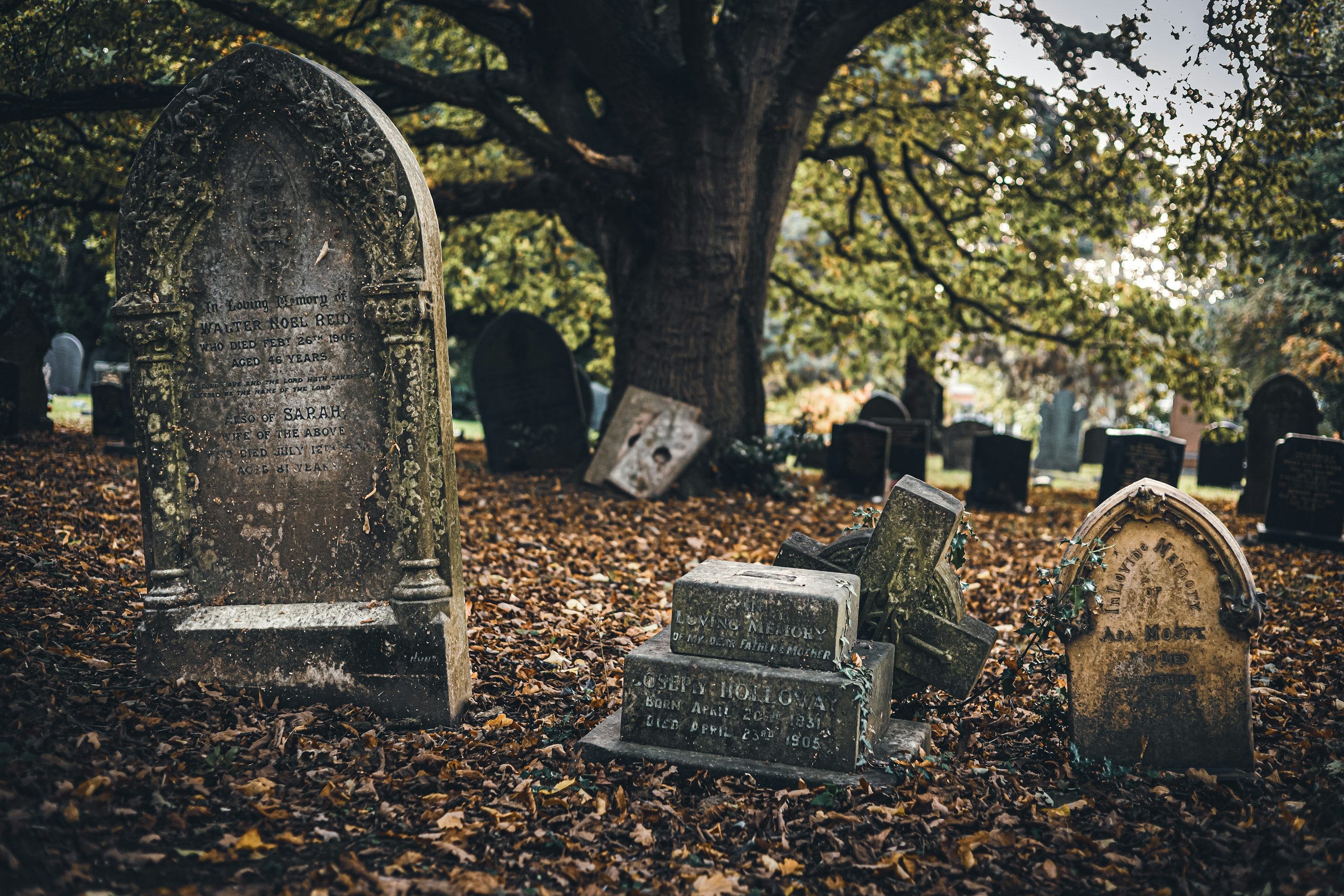
And that is why, this Halloween, when some local wag put up one of those fake gravestones in their front yard, they added the caption:
Here Lie All Those Who Tried To Turn Left on Mission.
Trust me, if you live in Santa Cruz, that’s a banger. When either entering or exiting Mission you know to gird your loins and commend your soul to God as soon as you flick on the turn signal. But you have to know at least a portion of all the above in order to get the joke right in your bones. Thank you for your patience.
I love humor that works for everybody, which touches upon some universal in the human experience, but I also have a soft spot for in-jokes that are impenetrable unless you happen to live in a certain place. They’re part of the town itself, a shadow of its geography and culture, the bawdy spirit that wanders only these specific streets.
Have you got any examples? What’s funny where you live?
Having grown up in Santa Cruz and, naturally, having learned to drive here, I can’t claim to be an expert on how people drive everywhere else , even though I have driven in plenty of other places. (I’ve just always assumed they were the ones doing it wrong. LOL.)
Up until the pandemic, I honestly thought Santa Cruz drivers operated with a kind of “efficient impatience” - or maybe “purposeful chaos”? Something in that neighborhood. But I will admit that driving here has changed. It’s become more of a death sport, practiced by people who seem blissfully unaware of, or completely unbothered by, the existence of traffic laws. And the sheer amount of gawd-awful daily traffic definitely isn’t helping anyone’s better instincts.
Also, fun fact (using the term loosely): I was hitchhiking all over Santa Cruz mountain roads during those “murder capital” years, blissfully unaware that bodies were turning up frighteningly close to where we lived. We were tucked into the mountains not far from at least one of the discovery sites, and I remain forever grateful to whatever angels were on duty, because statistically, I probably shouldn’t have made it out of my teenage years.
My home town? The only thing "hip" in Bradford on Avon is the replacements.